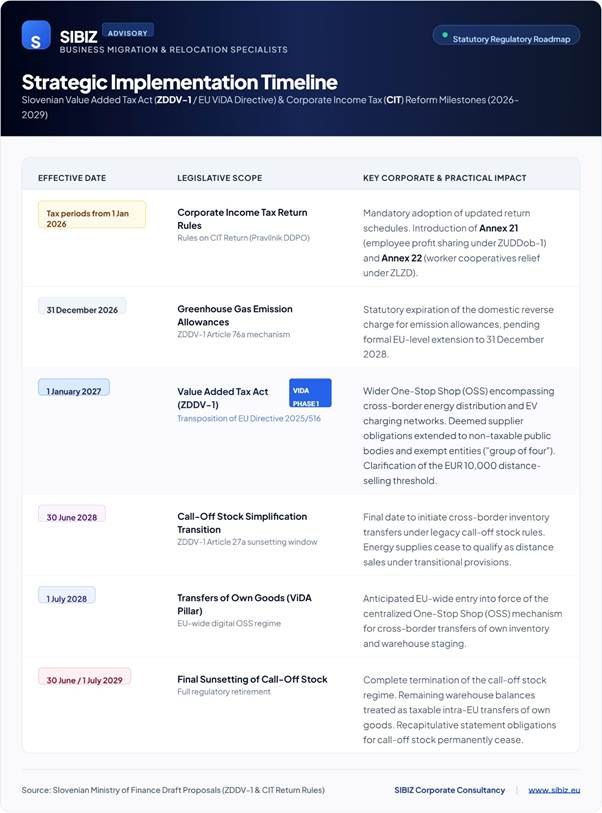
Proactively navigating the ever-changing landscape of European tax legislation requires operational agility, particularly when domestic adaptations converge with comprehensive European Union initiatives. Slovenia’s Ministry of Finance has introduced two significant legislative proposals that are set to transform the tax landscape for foreign businesses, cross-border traders and corporate entities.
The first draft targets the Value Added Tax Act (ZDDV-1) and its executive regulations, transposing critical pillars of the EU’s VAT in the Digital Age (ViDA) package (Council Directive (EU) 2025/516). The second draft amends corporate income tax reporting regulations, introducing reporting requirements that directly impact the 2026 fiscal year filings submitted to the Slovenian Tax Office (FURS).
Here is an executive breakdown of these upcoming regulatory shifts, practical timelines, and the direct operational implications for international businesses established or operating in Slovenia.
1. Value Added Tax Act (ZDDV-1): Major ViDA Adjustments
Most proposed changes to the Value Added Tax Act (ZDDV-1) are scheduled to apply from 1 January 2027, establishing greater reliance on centralized digital mechanisms while redefining stock and supply responsibilities.
Expansion of the One-Stop Shop (OSS)
The One-Stop Shop (OSS) mechanism—allowing businesses to declare and settle VAT due across multiple EU Member States via a single portal in their home jurisdiction—is undergoing strategic expansion:
Cross-Border Energy Supplies: Between 1 January 2027 and 30 June 2028, supplies of electricity, natural gas, and district heating/cooling will qualify as intra-EU distance sales under the OSS framework when the supplier is not established in the country of consumption. This provides immediate administrative relief to international operators, including operators of cross-border Electric Vehicle (EV) charging networks, who can leverage the OSS rather than maintaining multiple local VAT registrations.
Broadened Non-Union Scheme: Non-EU companies will now be permitted to utilize the non-Union OSS scheme when delivering services to non-taxable customers globally, removing previous restrictions that required recipients to reside within the EU.
Streamlined Administrative Filings: When registering for the Import One-Stop Shop (IOSS) or the non-Union OSS, businesses will only be mandated to list formal corporate website addresses if they actively operate them.
Input VAT Refund Access: Non-EU businesses operating under the Union OSS framework will gain the ability to reclaim Slovenian input VAT directly through the standard third-country refund procedure, irrespective of traditional reciprocity requirements and even while performing active supplies in Slovenia. Concurrently, EU entities utilizing the IOSS in another member state will be relieved of submitting non-supply declarations for Slovenian VAT refunds.
Extended “Deemed Supplier” Regime for Digital Platforms
Under existing statutes, digital marketplaces and e-commerce platforms facilitating intra-EU supplies on behalf of non-EU sellers bear deemed-supplier VAT liabilities when delivering to private consumers. The draft expands this liability to transactions involving non-taxable legal entities—frequently referred to as the “group of four”:
Non-taxable public bodies and institutions,
Farmers under flat-rate schemes,
Small enterprises operating under domestic VAT exemptions,
Fully exempt non-profit/educational bodies.
This rule applies provided their total annual intra-EU acquisitions remain beneath the statutory EUR 10,000 threshold and they have not proactively opted into local VAT accounting.
Clarifications to the EUR 10,000 Micro-Business Threshold
For small EU companies selling cross-border goods and telecommunications, broadcasting, and electronic services (TBE), the EUR 10,000 pan-EU threshold has been clarified:
Only goods dispatched directly from the supplier’s member state of establishment count toward the EUR 10,000 ceiling; shipments originating from warehouses or logistics hubs in other member states are excluded.
Businesses electing for destination-principle taxation below the threshold will remain bound to that election for the current year plus one subsequent calendar year (reduced from two subsequent years).
Active registration for the Union OSS automatically designates this election.
Phase-Out of Call-Off Stock Simplification
Under ViDA harmonizations, the traditional call-off stock regime—which allowed suppliers to preposition inventory at a customer’s warehouse in another EU state without triggering a foreign VAT registration—will be systematically decommissioned and superseded by a new OSS-based framework for transfers of own goods starting tentatively on 1 July 2028:
30 June 2028: Final deadline to initiate new inventory transfers under the call-off stock simplification.
30 June 2029: Absolute expiration for existing call-off stock inventory (retaining the standard 12-month storage window).
1 July 2029: Any unsold goods remaining in customer warehouses will legally trigger an intra-EU transfer of own goods, ending related historical recapitulative reporting requirements.
Domestic Reverse Charge for Carbon Emission Allowances
The domestic reverse charge applied to transactions involving greenhouse gas emission allowances is slated to expire on 31 December 2026. Slovenia’s draft incorporates a conditional extension through 31 December 2028, subject to the European Commission adopting formal EU VAT Directive updates by late 2026.
2. Corporate Income Tax Return: Rules & Form Revisions
While primary VAT overhauls take effect in 2027, amendments to the Rules on the Corporate Income Tax Return (Pravilnik o davčnem obračunu davka od dohodkov pravnih oseb) will impact filings for the 2026 tax period (payable by late March 2027).
These updates integrate two recent pieces of corporate legislation enacted in Slovenia:
The Employee Profit Sharing Act (ZUDDob-1)
The Employee Ownership Cooperative Act (ZLZD)
Administrative Updates to FURS Filings
Corporate entities reporting to the Slovenian Tax Office (FURS) will encounter:
Revised Standard Schedules: Modernization of Annexes 1, 2, 15, 16, and 17.
Annex 21 (New): Dedicated reporting schedule collecting verified distributions and tax relief metrics connected to formal employee profit-sharing schemes under ZUDDob-1.
Annex 22 (New): Explicit accounting disclosure for corporations claiming or repaying statutory corporate tax reliefs tied to employee ownership cooperatives established pursuant to ZLZD (specifically Articles 42 and 45).
What This Means for Your Business
Supply Chain & Logistics Operators: Cross-border inventory logistics will undergo structural change between 2028 and 2029. Multi-jurisdiction warehousing, consignment arrangements, and freight staging require immediate review to transition toward the new OSS transfer mechanisms.
Digital Marketplaces & Platforms: E-commerce systems must update checkout tax engines to account for deemed-supplier responsibilities when serving non-taxable public bodies and exempt entities.
Cross-Border EV Infrastructure: Electric mobility providers and energy distributors can consolidate European VAT registrations into their home jurisdiction via OSS beginning in 2027.
Corporate Financial Administration: Corporate controllers must update payroll and corporate balance sheet reporting procedures ahead of 2026 tax return filings to substantiate tax relief claims under the ZUDDob-1 and ZLZD frameworks.
Staying ahead of European and Slovenian tax compliance safeguards your operational margins and prevents costly administrative penalties.
About Us
At SIBIZ, we are proud to be the best in Slovenia in the fields of business migration, as well as corporate and individual relocation. We specialize in helping business professionals, corporate clients, and individuals navigate the complex landscape of Slovenian regulations and local administrative procedures. Our expert team is here to ensure your transition to Slovenia is smooth, compliant, and highly successful.
For more information: www.sibiz.eu
Get consultations and important information first hand!
Slovenia is on the brink of significant legal reforms affecting how foreign professionals and third-country nationals enter, reside, and work in the country. Two major legislative proposals—the draft amendment to the Foreigners Act (ZTuj) and the draft amendment to the Employment, Self-Employment and Work of Foreigners Act (ZZSDT)—have ignited an intense public debate among key […]
The Ministry of Economy, Labour and Sport (Ministrstvo za gospodarstvo, delo in šport) has officially published the draft amendments to the Employment, Self-Employment and Work of Aliens Act (ZZSDT) on the e-Demokracija public portal. This comprehensive legislative revision brings Slovenian labour regulations into line with Directive (EU) 2024/1233 (the recast Single Permit Directive). The proposed […]
Starting January 1, 2028, a major shift will transform the way business-to-business (B2B) transactions are handled in Slovenia: the mandatory exchange of electronic invoices. This change is mandated by the new Law on the Exchange of Electronic Invoices and Other Electronic Documents (ZIERDED). For foreign founders, expats running local businesses, and corporate managers overseeing operations […]