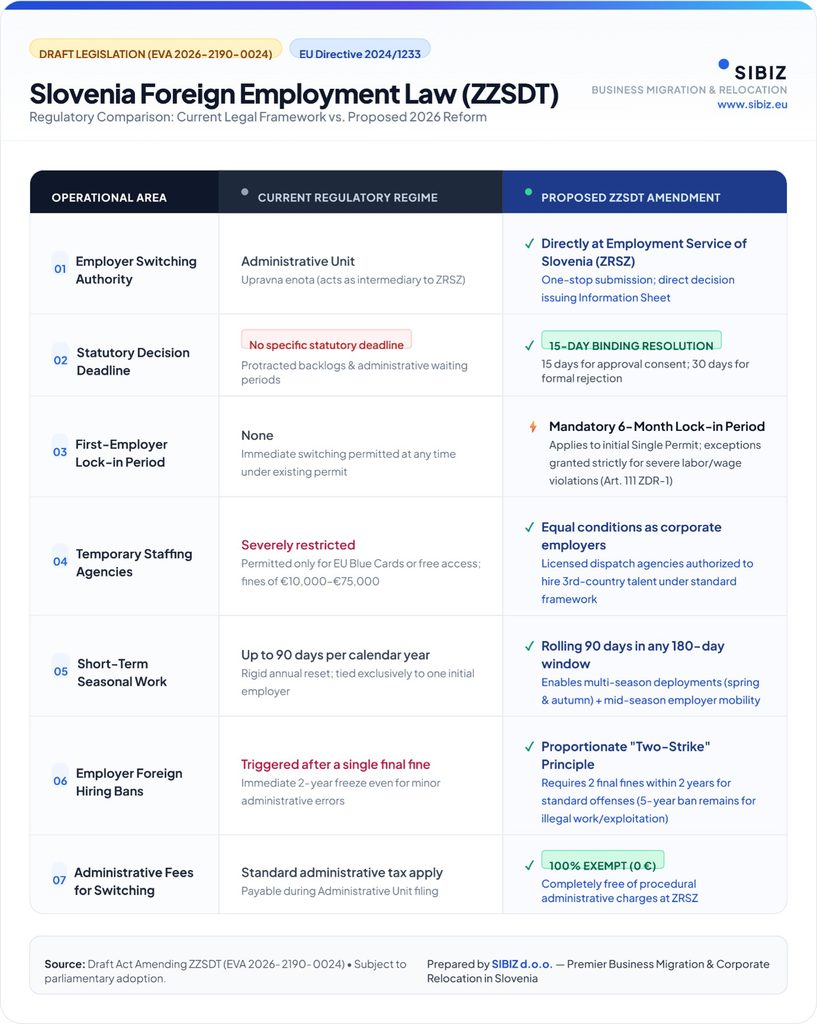
The Ministry of Economy, Labour and Sport (Ministrstvo za gospodarstvo, delo in šport) has officially published the draft amendments to the Employment, Self-Employment and Work of Aliens Act (ZZSDT) on the e-Demokracija public portal.
This comprehensive legislative revision brings Slovenian labour regulations into line with Directive (EU) 2024/1233 (the recast Single Permit Directive). The proposed amendments introduce faster procedures for switching employers, a new mandatory six-month lock-in period with the initial employer, the liberalisation of temporary work agencies, flexible rolling seasonal work allowances and a more proportionate sanctions system for employers.
The following executive guide outlines what the proposed draft entails, who it affects, and how corporate employers and international professionals should prepare.
At a Glance: Key Highlights of the Draft Reform
Decentralized Employer Switching: Applications to switch employers or job positions will be processed directly by the Employment Service of Slovenia (ZRSZ) (Zavod RS za zaposlovanje), with a statutory 15-day decision deadline for granting consent.
The 6-Month Initial Binding Period: A new rule prevents third-country nationals from switching employers during the first six months of work on their initial Single Permit (enotno dovoljenje), barring severe labor code violations by the employer.
Equal Footing for Temporary Work Agencies: Registered labor dispatch agencies will be permitted to hire foreign workers under the exact same statutory conditions as standard corporate employers.
Modernized Seasonal Work: A flexible rolling quota of 90 days in any 180-day period replaces the rigid calendar-year system.
Proportionate Employer Penalties: General hiring bans on foreign labor will require two final penalty orders within two years, rather than triggering after a single offense.
Enhanced Worker Protection: Explicit legal recognition for third-country workers to enforce their statutory rights via trade unions, legal counsel, or non-governmental organizations.
Legislative Status: This remains a draft bill subject to inter-ministerial review, government approval, and parliamentary debate. Existing procedures remain fully in force until formal enactment.
Scope: Who Is Impacted?
The proposed legislative changes apply directly to third-country nationals (citizens of countries outside the EU, EEA, and Switzerland) and Slovenian registered entities employing them.
The changes primarily impact:
Non-EU professionals working under a standard Single Permit for Work and Residence.
Highly qualified specialists holding an EU Blue Card (Modra karta EU).
Seasonal workers in sectors such as agriculture, forestry, tourism, and hospitality.
Corporate HR departments, recruitment consultancies, and temporary employment agencies.
Who is not affected?
Citizens of the European Union, the European Economic Area (EEA), and Switzerland retain full, unrestricted access to the Slovenian labor market. Similarly, third-country nationals with free access to the labor market (e.g., permanent residence holders, family members of Slovenian citizens, or individuals under international protection) do not require ZRSZ consent to take up employment.
Detailed Analysis: The 6 Core Pillars of the Draft Amendment
1. Direct Employer Switching via ZRSZ (15-Day Resolution)
Under the current legal regime, any change of employer or position requires an application submitted to the local Administrative Unit (Upravna enota). The administrative unit then solicits consent from the Employment Service of Slovenia (ZRSZ), waiting for a formal response before issuing an updated administrative card. This creates prolonged procedural backlogs.
The New Process:
Direct Submission: The foreign employee or the prospective employer files an application directly with the Employment Service of Slovenia (ZRSZ) using a standardized form.
Eligibility Verification: The Employment Service of Slovenia (ZRSZ) verifies whether statutory criteria are met (valid company registration, active business operations, and settled tax liabilities).
15-Day Approval & Information Sheet: If compliant, the ZRSZ issues consent within 15 days, delivers an Information Sheet (informativni list) to the applicant, and officially notifies both the Administrative Unit (Upravna enota) and the Health Insurance Institute of Slovenia (ZZZS) (Zavod za zdravstveno zavarovanje Slovenije).
Immediate Work Start: The employee can start working under the new terms immediately upon receipt of the Information Sheet and their valid existing Single Permit, eliminating the wait for a newly printed physical residence card.
Rejection Safeguards: In case of non-compliance, the ZRSZ must issue a formal rejection within 30 days, which is subject to appeal before the ministry responsible for labor.
No Administrative Fees: Applications, consents, and procedural decisions before the ZRSZ will be completely free of administrative fees.
2. The Six-Month Binding Rule with the First Employer
To balance labor mobility with the substantial investment employers make when recruiting abroad, the draft introduces a binding period: the Employment Service of Slovenia (ZRSZ) will not grant consent to switch employers during the first six months of employment under an initial Single Permit.
Scope: Applies strictly to changing employers under an initial Single Permit; it does not restrict internal promotions or job position changes within the same company, nor does it currently apply to EU Blue Card holders.
Exceptions for Severe Violations: Workers can break this six-month lock-in if there are grounds for extraordinary termination of the employment contract under Article 111 of the Employment Relationships Act (ZDR-1) (Zakon o delovnih razmerjih). Valid grounds include:
Failure to pay wages or significant underpayment.
Non-payment of compulsory social security contributions.
Protracted failure to provide work.
Failure to ensure occupational health and safety.
Failure to protect the worker against harassment, mobbing, or workplace mistreatment.
Any worker seeking an early transfer under these exceptions must provide concrete documentary evidence (e.g., bank statements, official payslips, or labor inspectorate records) with their application.
3. Equal Treatment for Temporary Work Agencies
Historically, registered temporary employment agencies (agencije za posredovanje dela) faced severe restrictions, allowed only to recruit third-country nationals who held an EU Blue Card, enjoyed free labor market access, or met narrow pre-qualification criteria in Slovenia—under threat of fines ranging from €10,000 to €75,000.
The draft amendment repeals these limitations:
Level Playing Field: Licensed employment agencies will be authorized to employ third-country nationals under the same regulatory framework applicable to any standard corporate employer.
Enhanced Compliance: Recognizing that unregulated labor brokering often proliferated among unregistered shadow companies, the legislator aims to bring foreign labor supply under registered, heavily audited staffing agencies, bolstering worker protection and legal transparency.
4. Modernized, Rolling Seasonal Work Allowances
Seasonal work—critical for Slovenia’s agricultural, forestry, and hospitality industries—receives a significant modernization:
Rolling 180-Day Window: Instead of capping short-term seasonal work at 90 days per calendar year, the draft establishes a dynamic threshold of up to 90 days within any rolling 180-day timeframe. This enables enterprises to employ seasonal staff across split peaks (e.g., both spring planting and autumn harvesting) within a single year.
Mid-Season Employer Mobility: Seasonal laborers holding a long-term Single Permit for seasonal work will be entitled to switch employers mid-season, provided the incoming employer meets all regulatory prerequisites. Consents will be adjudicated by the ZRSZ within 15 days.
5. Proportionate Employer Sanctions: The “Two-Strike” Principle
Slovenian labor law has historically imposed unforgiving sanctions. For instance, allowing an employee to perform work not explicitly covered by their consent could result in an immediate two-year corporate ban on employing foreign staff, alongside hefty monetary fines.
The draft proposal restores commercial proportionality:
Two Strikes in Two Years: For most standard labor law and occupational safety infractions, an employment ban on third-country nationals will only be triggered after an enterprise receives two final, non-appealable administrative fines (pravnomočne globe) within a two-year timeframe.
Zero Tolerance for Grave Abuses: Immediate five-year bans remain mandatory for non-negotiable offenses, including:
Undeclared and illegal employment of third-country nationals.
Criminal offenses involving human trafficking, forced labor, and severe worker exploitation.
Worker Liability: A foreign national working without valid authorization continues to face an individual two-year ban on lawful work in Slovenia (or a five-year ban in cases involving forged documentation).
6. Robust Enforcement and Third-Party Worker Representation
To comply with EU worker protection mandates, the draft reinforces procedural rights:
Legal Representation: Foreign workers are explicitly empowered to assert their employment claims through certified third parties, such as labor unions, specialized non-governmental organizations, or legal attorneys.
Inter-Agency Audits: High-risk economic sectors will face coordinated, joint inspection audits conducted by multiple state inspectorates simultaneously.
Unemployment Protection: Unemployment alone will no longer result in the immediate revocation of a Single Permit (allowing a protection window of up to 3 months, or up to 6 months for workers who have held a permit for more than two years, as governed in tandem with the Aliens Act).
Regulatory Comparison: Current Law vs. Proposed Reform
Strategic Takeaways for Businesses and Foreign Professionals
For Corporate Employers & HR Leaders
Audit Onboarding Timelines: Factor the 6-month lock-in into your workforce retention planning. Understand that employees are legally anchored to your enterprise initially, provided your compliance with wage and safety regulations remains pristine.
Review Agency Partnerships: Prepare for the liberalization of temporary staffing agencies, which will offer flexible contingency hiring for rapid industrial or project scaling.
Institutionalize Compliance: While the shift to a two-strike sanction system provides operational breathing room against minor administrative oversights, two accumulated fines still impose a catastrophic multi-year freeze on foreign recruitment.
For Foreign Professionals & Expats
Thorough Contract Review: Because you will generally be committed to your first employer for six months, meticulously review wage terms, job descriptions, and working conditions before signing.
Document Everything: If an employer fails to pay compulsory social contributions or delays wage payments, retain all bank statements, written communications, and payslips. You will need this evidence to switch employers during the initial six months.
Never Work Prematurely: Do not commence tasks for a new employer until you have received the official Information Sheet from the ZRSZ. Unauthorized work can lead to personal fines and a two-year ban on working in Slovenia.
7. Connecting the Pieces: Parallel Revisions to the Foreigners Act (ZTuj-2)
The proposed reform of the Employment, Self-Employment and Work of Aliens Act (ZZSDT) does not operate in isolation. In the Slovenian legal framework, foreign employment and foreign residency are intimately intertwined: while the ZZSDT regulates the labor market consent and workplace conditions, the Foreigners Act (ZTuj-2) (Zakon o tujcih) governs the issuance of residence titles, family reunification criteria, subsistence thresholds, and integration standards.
Both pieces of legislation are being concurrently modernized to align with European Union directives and address persistent administrative bottlenecks at local Administrative Units. For employers and international professionals alike, mastering labor clearance is only half the journey—ensuring that income thresholds, family permits, and language certifications are met remains equally paramount.
To explore how the companion immigration reforms will impact residency status and family members, read our detailed analysis here:
At SIBIZ, we are proud to be the best in Slovenia in the fields of business migration, as well as corporate and individual relocation. We specialize in helping business professionals, corporate clients, and individuals navigate the complex landscape of Slovenian regulations and local administrative procedures. Our expert team is here to ensure your transition to Slovenia is smooth, compliant, and highly successful.
Slovenia is on the brink of significant legal reforms affecting how foreign professionals and third-country nationals enter, reside, and work in the country. Two major legislative proposals—the draft amendment to the Foreigners Act (ZTuj) and the draft amendment to the Employment, Self-Employment and Work of Foreigners Act (ZZSDT)—have ignited an intense public debate among key […]
Starting January 1, 2028, a major shift will transform the way business-to-business (B2B) transactions are handled in Slovenia: the mandatory exchange of electronic invoices. This change is mandated by the new Law on the Exchange of Electronic Invoices and Other Electronic Documents (ZIERDED). For foreign founders, expats running local businesses, and corporate managers overseeing operations […]
A recent judgment delivered by the European Court of Human Rights (ECHR) in Strasbourg has set a significant precedent regarding the limits of family reunification across Europe. On 8 September 2026, the Court unanimously ruled in favour of the Netherlands in the case of A.A. v. the Netherlands (Application no. 7481/23), deciding that the Dutch […]