Students, both Slovenian and international, are often vulnerable when renting accommodation. Many (especially international students) are not fully familiar with the local housing market, legal regulations or their rights, which makes them more vulnerable to unfair practices.
With the new academic year starting on October 1, many students will be looking for rooms or apartments. Renting from private landlords is common, but both students and landlords need to understand the specifics to avoid problems later.
Key Guidelines for Student Rentals
1. Always sign a detailed rental agreement A clear contract defines the legal relationship between landlord and tenant, enables proper residence registration, and protects both sides. Avoid informal or vague agreements that can cause disputes later. It is strongly recommended that a legal professional drafts or reviews the rental contract to ensure it is complete and enforceable.
2. Subsidy available only with registered landlords If renting from a landlord registered in the official student housing scheme, students may receive a state subsidy for the academic year 2025/26:
38.92 EUR/month in public dormitories (secondary school/mixed/student halls)
100.64 EUR/month in private student dormitories or private rentals
3. Minimum conditions for subsidized rentals Registered landlords must provide:
furnished room (bed, wardrobe, desk, chair) plus access to bathroom and toilet
heating, hot & cold water, electricity, internet, cooking facilities
proper maintenance and clean shared spaces
suitable housing when the student has a child
4. Temporary residence address registration is mandatory Students staying more than 90 days must register a temporary residence at the local administrative office within 8 days of moving in. The landlord cannot prevent this. A signed rental contract is necessary for the process.
Notice Periods for Lease Termination
Slovenian Housing Act (Stanovanjski zakon) sets clear rules for lease termination.
By Tenant
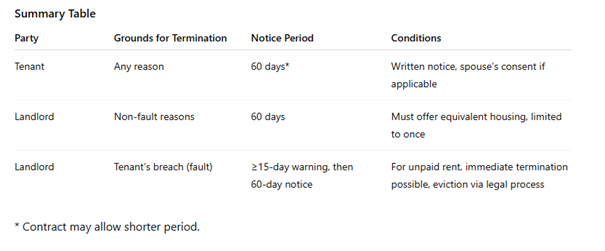
The tenant may terminate the lease at any time, without giving a reason.
Termination must be in writing.
If the tenant is married and only one spouse is listed, the other spouse’s written consent is required.
Standard notice period: 60 days, unless the contract specifies a shorter period.
By Landlord – Non-fault termination
Notice period: 60 days, regardless of any shorter period written in the contract.
The landlord must provide the tenant with alternative suitable housing that does not worsen living conditions (size, layout, amenities).
This type of termination is generally limited to one instance only (with exceptions for municipalities or public housing providers).
By Landlord – Fault-based termination (tenant’s breach)
The landlord must first issue a written warning, allowing at least 15 days for the tenant to correct the breach.
If unresolved, the landlord can then terminate with a 60-day notice.
In case of unpaid rent or costs, the landlord may terminate immediately with written notice and demand eviction. However, eviction must follow proper legal procedure (court or enforcement).
Summary Table
Practical Advice for Both Parties
Always get a written receipt or confirm payment of a deposit.
Inventory and photograph the room’s state before moving in.
Request written confirmation for each cash rent payment.
Landlords may request a guarantor (e.g., parent) for added security.
Get a professional to help you prepare a rent agreement (lawyres, legal expert)
Slovenia is on the brink of significant legal reforms affecting how foreign professionals and third-country nationals enter, reside, and work in the country. Two major legislative proposals—the draft amendment to the Foreigners Act (ZTuj) and the draft amendment to the Employment, Self-Employment and Work of Foreigners Act (ZZSDT)—have ignited an intense public debate among key […]
The Ministry of Economy, Labour and Sport (Ministrstvo za gospodarstvo, delo in šport) has officially published the draft amendments to the Employment, Self-Employment and Work of Aliens Act (ZZSDT) on the e-Demokracija public portal. This comprehensive legislative revision brings Slovenian labour regulations into line with Directive (EU) 2024/1233 (the recast Single Permit Directive). The proposed […]
Starting January 1, 2028, a major shift will transform the way business-to-business (B2B) transactions are handled in Slovenia: the mandatory exchange of electronic invoices. This change is mandated by the new Law on the Exchange of Electronic Invoices and Other Electronic Documents (ZIERDED). For foreign founders, expats running local businesses, and corporate managers overseeing operations […]