From the start of the new year, Slovenia will begin applying the new Hospitality Act, which directly affects short-term apartment rentals marketed through platforms such as Airbnb and Booking.com. While time limits on short-term rentals in municipalities with a high risk of negative impacts will not apply until January 1, 2027, the new framework already introduces significant operational and compliance obligations for property owners who rely on online booking platforms for tourist rentals.
According to the Ministry of Economy, Tourism and Sport, the new regulation aims to balance tourism development, housing availability and local community interests. In practice, the law will significantly change the way Airbnb and Booking.com hosts operate, especially in apartment buildings and urban tourist destinations. The ordinance has drawn strong opposition from private lodging operators and industry groups.
Key regulatory changes affecting Airbnb and Booking.com rentals
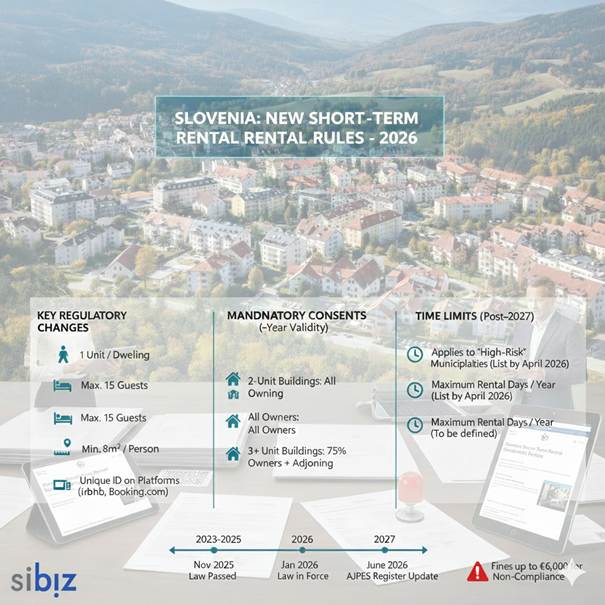
The new Hospitality Act sets clear limits on how accommodation units can be registered and operated, which is particularly relevant for short-term rentals advertised on Airbnb and Booking.com. Only one lodging unit, such as an apartment, room, or vacation home, may be registered per dwelling, even if it consists of multiple units. The total capacity is limited to 15 guests, with a minimum of 8 square meters of usable space per person.
When advertising accommodation or concluding distance contracts through digital platforms, providers must clearly state a valid accommodation identification number. This obligation directly affects listings on Airbnb, Booking.com and similar online platforms. The Accommodation Establishments Register, managed by AJPES, must be updated with additional data by June 30, 2026, and the system upgrade is currently underway.
Time Limits and High Risk Communities
Limits on the number of rental days per year will not apply until after January 1, 2027. These restrictions will apply to municipalities classified as having a high risk of negative impacts from short-term rentals, in particular cities and tourist areas with a high concentration of Airbnb and Booking.com listings. The list of such municipalities must be published by April 30, 2026, or the restrictions will apply in municipalities that adopt a general law to that effect.
Mandatory consents and owner approvals for platform-based rentals
Formal consents are required to legally engage in short-term rental activities, including rentals booked through Airbnb or Booking.com. In all cases, the consent of all owners or co-owners of the unit is required. In two-unit buildings, the consent of all unit owners in the building is required. In three-unit or multiunit buildings, consent must be obtained from unit owners holding more than three-fourths of the units, including all unit owners whose units adjoin the rental unit. Each consent is valid for three years.
Additional transparency requirements apply to multi-family buildings. Providers must publicly post the start date of the rental activity on a notice board or in a location accessible to all co-owners. A standardized decal showing the expiration date of the approval must also be placed on the front door of the apartment. These stickers will be available for free at SPOT locations beginning in the second half of January.
Strong opposition from short-term rental hosts
Private accommodation providers, including many Airbnb and Booking.com hosts, argue that the new law creates regulatory uncertainty and operational chaos. They point to potential fines for missing stickers, the inability to register new hosts, and alleged inconsistencies with EU-level regulation.
The Association of Private Accommodation Providers of Slovenia, the Hospitality of Slovenian Homes Institute and the Association of Property Owners in Slovenia have formally requested an urgent meeting with the relevant ministries, the government and the National Council’s Committee for the Economy, Craft, Tourism and Finance. The meeting is expected to take place by January 7.
Industry representatives also warn of unrealistically short implementation deadlines, especially given that the law will come into force during the peak winter tourism season, which is critical for tourism revenues based on Airbnb and Booking.com. They stress that the authorities are not operationally ready, noting that two key secondary regulations have not yet been updated, namely the rules on minimum technical requirements and scope of services, and the rules on accommodation categorization.
Despite the lack of updated secondary legislation, accommodation providers face potential fines of up to €6,000 for non-compliance. Industry groups are therefore calling for a six-month moratorium on sanctions and clear assurances from the authorities.
According to providers, the current approach risks undermining one of the traditional pillars of Slovenian tourism, affecting tens of thousands of households that earn income primarily from short-term rentals on digital platforms, and impacting local and state budgets.
What this means for Airbnb and Booking.com property owners and investors
If you own or plan to invest in residential property for tourist rental through Airbnb or Booking.com in Slovenia, early compliance planning is essential. The new rules have significant implications for capacity limits, registration procedures, advertising requirements on booking platforms, and co-owner relationships. Investors and business professionals should closely monitor upcoming municipal decisions, secondary legislation, and enforcement practices throughout 2026.
Quick Q & A for Airbnb and Booking.com hosts
Does the new law apply to Airbnb and Booking.com rentals Yes. The Hospitality Act fully applies to short-term tourist rentals advertised and booked through Airbnb, Booking.com and similar platforms.
Do I need to change my Airbnb or Booking.com listing? Each listing must include a valid property identification number. Listings without this information risk removal and fines.
Can I continue to rent without co-owner consent? No. Owner and co-owner consent is mandatory. Without valid consent, short-term rental activity is not permitted.
After January 1, 2027, and only in municipalities classified as high risk or where local legislation imposes restrictions.
What happens if secondary legislation is not yet adopted Current enforcement still allows for fines of up to EUR 6,000, which is why industry groups are calling for a six-month moratorium on sanctions.
Is now a good time to invest in Airbnb properties in Slovenia Only with careful legal and regulatory assessment. The new framework significantly affects returns, scalability and compliance costs.
About SIBIZ
SIBIZ Business Services Ltd. advises foreign investors, digital nomads, business professionals and corporate clients on real estate structuring, regulatory compliance, immigration, tax, and business setup in Slovenia. We support clients who operate Airbnb and Booking.com properties through changing regulatory frameworks and help them assess risks before making investment decisions.
For business professionals, corporate clients, and individuals operating within the Slovenian logistics and transport sector, staying ahead of regulatory shifts is essential. Recently, the Slovenian Parliament’s Committee on Labour took a significant step by confirming proposed amendments to the Cross-Border Provision of Services Act. This legislative move aims to redefine how international road transport companies […]
Important Update for Sole Proprietors (s.p.) in Slovenia: New Re-entry Rules for the Lump-Sum Tax System (“Normiranec”) The National Assembly of the Republic of Slovenia has officially approved key changes to the Zakon o dohodnini (Personal Income Tax Act). These changes specifically impact the s.p. (samostojni podjetnik or sole proprietor) operating under the “normiranec” system, […]
Ljubljana, February 17, 2026 Significant updates have been announced regarding the proposed tax amendments for sole traders (s.p.) in Slovenia. Following public debate and coordination with social partners, coalition MPs have revised the proposal for the “normirani odhodki” (standardized expenses) regime, commonly known as the flat-rate tax system. The revised draft focuses on re-entry conditions […]