IMPORTANT DISCLAIMER: The changes described below reflect a PROPOSED LEGISLATIVE DRAFT published by the Ministry of the Interior (MNZ) for the Foreigners Act (ZTuj-2J). The public consultation period has been extended to August 26, 2026. These provisions are not yet final law and remain subject to legislative debate and parliamentary approval.
This legislative proposal introduces structural updates to immigration and relocation regulations in Slovenia. Implementing EU Directive 2024/1233 (Single Permit Directive), the draft significantly increases the financial threshold requirements and language standards for foreign residents, while shifting the administrative job change procedures to streamline processing.
Below is SIBIZ ‘s expert analysis of what corporate employers, foreign professionals and individual expats need to know about these potential regulatory changes.
1. Doubling of the financial requirement for means of subsistence (+100%)
One of the most impactful elements of the draft Aliens Act (ZTuj-2J ) is the exact doubling (+100% ) of the financial threshold for means of subsistence.
In practice, since the weighting factors (ponderji) remain unchanged, each required income threshold is simply doubled (+100%) across all permit categories.
How the calculation base works
Under Slovenian law, the calculation of the subsistence level is tied to the basic minimum income set by the Financial Social Assistance Act (ZSVarPre ) (indexed periodically, last adjusted in March 2026 to €507.43).
The proposed amendment does not change the statutory weighting factors (ponderji), but doubles the underlying basic multiplier from 1.0 times the basic minimum income to 2.0 times the basic minimum income:
Current standard: Single applicant baseline = €507.43 per month.
Proposed Standard: Single applicant baseline = €1,014.86 per month (closely approximates Slovenia’s net minimum wage of approximately €1,000).
Accepted sources of income: Active, Passive and Savings (Already Applicable Under Current Law)
It is important to emphasize that the criteria for acceptable sources of income will not change– these rules already apply under the current legal framework and will remain the same under the proposed amendment. In demonstrating sufficient resources, applicants will continue to be able to demonstrate eligibility through both active and passive income streams, as well as accumulated liquid assets:
Active income: Earnings from employment or work, entitlements from work, or social security.
Passive Income & Capital: Income from property rental, dividends, capital gains, scholarships and support from persons legally obligated to support the applicant.
Bank Savings & Liquid Assets: Documented financial reserves held in bank or savings accounts either in Slovenia or abroad.
2. Family Reunification Financial Calculations (Ponder Breakdown)
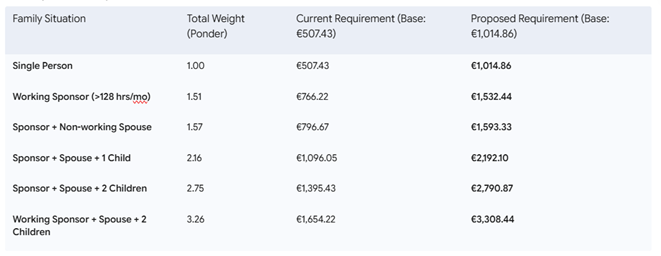
Because family reunification thresholds are calculated using weighting factors (ponderji) in ZSVarPre, doubling the base means that each required family income bracket doubles (+100%).
Weighting Factors (Ponderji):
Primary Applicant/Sponsor: 1.00
Working primary sponsor (more than 128 hours/month): +0.26 or +0.51 (depending on amount of work)
Each additional adult (spouse/partner): +0.57
Each dependent child: +0.59
Side-by-Side Comparison Table
Note on indexation: Exact future monetary figures will depend on the official indexation of the basic minimum income at the time of enactment. However, the rule of doubling the required amounts (+100%) applies regardless of future base adjustments.
3. Practical implications for employers and expatriate families
High net worth thresholds: A family of four with a working sponsor must have a net monthly income of approximately €3,300 or equivalent liquid financial reserves. This is approximately two average Slovenian net salaries or more than three minimum net salaries.
Exclusion of allowance reimbursements: Income compliance is verified through tax returns submitted to the Slovenian Tax Office (FURS), employment contracts, or financial statements. Non-taxable reimbursements – such as daily meal allowances(malica) and travel reimbursements(prevoz) – cannotbe included in the calculation of living expenses.
Impact on Minimum Wage Earners: For foreign workers earning the minimum wage or slightly above, supporting a family on salary alone will become financially unfeasible unless supported by additional passive income or verified bank savings (both of which remain fully valid under existing rules). For individual permit holders, maintaining full-time minimum wage employment will be the absolute baseline.
4. Extended waiting period for family reunification (1 to 3 years)
Under the current rules, third-country nationals holding a temporary residence permit may apply for family reunification after 1 year of continuous lawful residence.
The proposed amendment extends this continuous residence requirement from 1 year to 3 years. Third-country nationals, including beneficiaries of subsidiary protection, will have to reside legally in Slovenia for three full years before they are eligible to sponsor family members for temporary residence permits.
5. Higher language proficiency standards & co-financing model
The draft proposes higher Slovenian language proficiency standards for all permit extensions and permanent residence:
Family Reunification Extensions: Requirements for adult family members applying for permit extensions will be raised from survival level to basic level A2 of the Common European Framework of Reference for Languages (CEFR).
Permanent Residence Permit (EU Long-Term Resident Status): The required language level will be raised from A2 to B1 intermediate.
End of Fully State-Funded Language Programs
The state plans to replace 100% free language courses with a co-financing model:
60% government co-financing: the government will cover 60% of course costs for official adult integration programs.
40% Learner Contribution: Foreign learners will pay 40% (estimated between €237.90 and €292.80 for a 180-hour course, or ~€1.30-€1.65 per hour).
Self-funded exams: Free initial language exams will be eliminated; candidates will pay exam fees directly to improve course participation and completion rates.
6. Faster Job Changes: Administrative Shift to ZRSZ
In order to reduce backlogs at local administrative units (Upravne enote), the authority to change jobs and employers will be transferred directly to the Employment Service.
Direct processing byZRSZ: Permits to change employers, change positions within the same company, or work for multiple employers under a single permit or EU Blue Card will be processed directly by the Employment Service of Slovenia (ZRSZ).
Employer Fee Policy: Employers who pay administrative fees on behalf of foreign employees cannot claim reimbursement from the employee.
Unemployment Protection: Single-entry permit holders who become unemployed are granted a temporary grace period before their permits are revoked, provided they are receiving unemployment benefits or have sufficient documented personal funds.
What Should Employers and Foreign Residents Do Next?
As this legislation is still a draft, employers, human resource managers and foreign professionals should review current foreign worker permit expiration dates and evaluate potential family sponsorship timelines before the new thresholds take effect.
About Us
At SIBIZ, we pride ourselves on being the best in Slovenia in the areas of business migration, corporate relocation and individual relocation. We specialize in helping business professionals, corporate clients and individuals navigate the complex landscape of Slovenian regulations and local administrative procedures. Our team of experts is here to ensure that your transition to Slovenia is smooth, compliant, and highly successful.
Slovenia is on the brink of significant legal reforms affecting how foreign professionals and third-country nationals enter, reside, and work in the country. Two major legislative proposals—the draft amendment to the Foreigners Act (ZTuj) and the draft amendment to the Employment, Self-Employment and Work of Foreigners Act (ZZSDT)—have ignited an intense public debate among key […]
The Ministry of Economy, Labour and Sport (Ministrstvo za gospodarstvo, delo in šport) has officially published the draft amendments to the Employment, Self-Employment and Work of Aliens Act (ZZSDT) on the e-Demokracija public portal. This comprehensive legislative revision brings Slovenian labour regulations into line with Directive (EU) 2024/1233 (the recast Single Permit Directive). The proposed […]
Starting January 1, 2028, a major shift will transform the way business-to-business (B2B) transactions are handled in Slovenia: the mandatory exchange of electronic invoices. This change is mandated by the new Law on the Exchange of Electronic Invoices and Other Electronic Documents (ZIERDED). For foreign founders, expats running local businesses, and corporate managers overseeing operations […]