Real estate tax in Slovenia 2026 – What homeowners need to prepare for
Slovenia will keep the same real estate tax brackets in 2026 as in 2025. This has been confirmed by the Ministry of Finance in its latest proposal for the annual revaluation rules. This article summarizes the key points for homeowners and investors and explains how the tax base, exemptions, deadlines and relief options work.
Who Pays Property Tax in 2026
Property tax applies to all natural persons individuals who own houses, apartments, garages or recreational properties, regardless of whether they live in them or rent them out.
Taxpayers include:
Residents and non residents
Owners and holders of usage rights
The tax is paid once per year, based on a decision issued by the Financial Administration (FURS).
Unchanged Tax Brackets for 2026
The Ministry of Finance decided not to change the tax brackets for 2026. This means that 2025 and 2026 taxation will be identical.
In previous years, the brackets normally increased annually, but this time the brackets remain fixed.
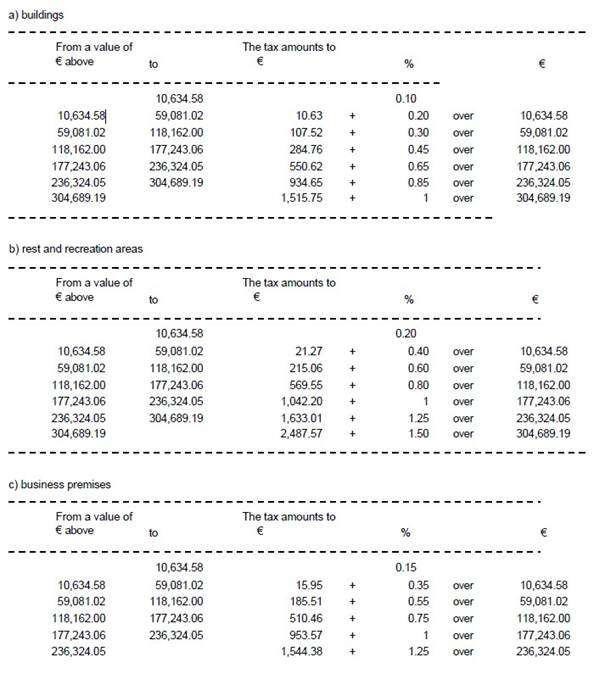
Tax Brackets for 2026
Below are the official 2026 tax brackets for:
Buildings
Rest and recreation areas
Business premises
The image you see in the post presents the exact values used for calculating property tax in 2026, including:
Minimum and maximum value ranges
Fixed tax amounts
Additional percentage rates applied on value above each threshold
These brackets remain unchanged from 2025 and will apply throughout 2026.
How the Tax Base Is Calculated
The tax base is the official value of the property. It is determined using the rules on valuation points, which depend on:
Useful area
Construction quality
Age
Additional property characteristics
Each property receives a value based on a points system multiplied by the value per point.
The 160 m² Deduction Rule
One of the most important elements of the system is the 160 m² deduction.
The tax base is reduced by the value of 160 square metres, but only if:
The owner, their close family member or the holder of usage rights lived in the property during the previous tax year.
Examples:
A 250 m² house used as a primary residence is taxed only on 90 m².
A property below 160 m² used as a primary residence pays no property tax.
Property Tax in Co Ownership
For co owned properties, everything is calculated proportionally.
Example for a 250 m² house with two equal co owners:
Each owns 125 m²
Each receives 80 m² of deduction
Each pays tax on 45 m²
Co ownership does not eliminate the tax obligation if the total property exceeds 160 m².
Who Must File a Tax Return and When
You must file a tax return when:
You buy a property
You build a new property, within 15 days of the occupancy permit
The tax return is filed at the local tax office where the property is located. FURS then issues a yearly decision with the amount due.
Failure to file is a violation that may result in a fine of 250 to 400 EUR.
Who Does Not Pay Property Tax
Full exemption applies to:
Residential properties up to 160 m² used as the primary residence
Agricultural buildings
Business premises used by the owner for their business activity
Residential buildings owned by farmers insured under agricultural income rules
Buildings protected as cultural or historical monuments
Buildings that cannot be used for objective reasons
Important: individuals with multiple properties are not exempt, even if some properties are smaller than 160 m².
Temporary Exemptions
Some taxpayers qualify for a temporary exemption:
First owners of new houses, apartments or garages – exemption for 10 years
Heirs who inherit new buildings – exemption continues under the same rights
Renovated buildings – exemption applies if the value increased by more than 50 percent
Reduced Property Tax for Large Families
Families with more than three household members living permanently in the property receive:
A 10 percent reduction for the fourth member
An additional 10 percent reduction for each further member
Deadline for Exemption Applications
Applications for exemption or reduced tax must be submitted to FURS no later than 31 January.
There is no official form. You must send a signed written statement. If the deadline is missed, the exemption will not be granted for that year.
Why Homeowners and Investors Work With SIBIZ
Property taxation in Slovenia includes legal conditions, valuation rules, reporting deadlines and exemption options. Errors can increase tax liability or trigger fines.
SIBIZ supports property owners and investors with:
Tax compliance reviews for property holdings
Assessment of exemption eligibility
Support with filings and documentation
Advice for foreign owners entering the Slovenian market
Clear guidance in English for long term planning
Our team works with foreign investors, homeowners, entrepreneurs, relocation clients and business professionals who want reliable and predictable support.
About SIBIZ
SIBIZ is a Ljubljana based advisory firm supporting foreign companies, investors, digital nomads and business professionals in Slovenia and the EU. We provide company formation, accounting, payroll, labour law guidance, relocation and immigration support and full ongoing corporate services.
Our specialists follow every regulatory update and translate complex rules into clear, actionable steps.
A recent judgment delivered by the European Court of Human Rights (ECHR) in Strasbourg has set a significant precedent regarding the limits of family reunification across Europe. On 8 September 2026, the Court unanimously ruled in favour of the Netherlands in the case of A.A. v. the Netherlands (Application no. 7481/23), deciding that the Dutch […]
Every September marks a critical milestone in international tax compliance: the annual implementation of the OECD Common Reporting Standard (CRS) and EU Administrative Cooperation Directives. In more than 100 tax jurisdictions worldwide, financial institutions share detailed account and asset data with national tax authorities. In Slovenia, this incoming data stream lands directly at the Slovenian Tax Authority (FURS). […]
IMPORTANT DISCLAIMER: The changes described below reflect a PROPOSED LEGISLATIVE DRAFT published by the Ministry of the Interior (MNZ) for the Foreigners Act (ZTuj-2J). The public consultation period has been extended to August 26, 2026. These provisions are not yet final law and remain subject to legislative debate and parliamentary approval. This legislative proposal introduces […]