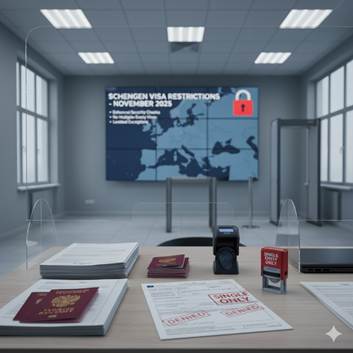
Brussels, November 2025 – The European Commission has adopted stricter rules for issuing Schengen visas to Russian citizens. The new measures, which come into force this Saturday, are a response to the growing security risks associated with Russia’s ongoing aggression against Ukraine.
EU High Representative Kaja Kallas highlighted recent drone incidents and acts of sabotage on European soil, calling them an unprecedented threat to European security.
Under the new rules, Russian citizens will no longer be eligible for multiple-entry Schengen visas. Instead, they will have to apply for a new visa for each trip to the EU. According to the Commission, this will allow authorities to conduct more frequent and thorough background checks to limit potential threats to internal security.
“All visa applications from Russian citizens will now be subject to enhanced screening procedures. This step will strengthen the integrity and security of the Schengen area,” said EU Home Affairs Commissioner Magnus Brunner.
Certain exceptions will remain in place, including for independent journalists, human rights defenders and close family members of EU citizens and Russian nationals legally residing in the EU. These groups will still be able to obtain multiple-entry visas.
The Commission said the decision reflects a joint assessment by EU member states, which unanimously supported the tightening of visa rules.
Kallas stressed that “Russia’s illegal invasion of Ukraine has created the most dangerous security environment in Europe for decades. We now face drone interference and sabotage across our territory. It is our duty to protect our citizens. Travel within the EU is a privilege, not a right”.
Since the suspension of the 2007 EU-Russia visa facilitation agreement in September 2022, visa access for Russian citizens has already been significantly reduced. According to the European Commission, the number of Schengen visas issued to Russians has fallen from over four million in 2019 to around 500,000 in 2023.
In addition, the EU’s 19th sanctions package, adopted last month, introduces a new mechanism to restrict the movement of Russian diplomats within the Schengen area. It is set to take effect by the end of January 2026.
Key takeaways for businesses and travelers:
Russian citizens will need a new Schengen visa for every trip.
Security checks for visa applicants will be intensified.
Limited exceptions remain for journalists, activists and family members of EU residents.
The move reflects coordinated EU-wide security measures in response to geopolitical threats.
About SIBIZ Business Services SIBIZ Business Services Ltd, based in Ljubljana, Slovenia, provides accounting, tax, legal and business advisory services to foreign entrepreneurs, corporate clients, companies and investors. We help clients navigate Slovenian and EU regulations with clear and practical solutions. Our support covers company formation, residence and work permits, digital nomad visas, relocation, compliance and day-to-day operational support.
Slovenia is on the brink of significant legal reforms affecting how foreign professionals and third-country nationals enter, reside, and work in the country. Two major legislative proposals—the draft amendment to the Foreigners Act (ZTuj) and the draft amendment to the Employment, Self-Employment and Work of Foreigners Act (ZZSDT)—have ignited an intense public debate among key […]
The Ministry of Economy, Labour and Sport (Ministrstvo za gospodarstvo, delo in šport) has officially published the draft amendments to the Employment, Self-Employment and Work of Aliens Act (ZZSDT) on the e-Demokracija public portal. This comprehensive legislative revision brings Slovenian labour regulations into line with Directive (EU) 2024/1233 (the recast Single Permit Directive). The proposed […]
Starting January 1, 2028, a major shift will transform the way business-to-business (B2B) transactions are handled in Slovenia: the mandatory exchange of electronic invoices. This change is mandated by the new Law on the Exchange of Electronic Invoices and Other Electronic Documents (ZIERDED). For foreign founders, expats running local businesses, and corporate managers overseeing operations […]