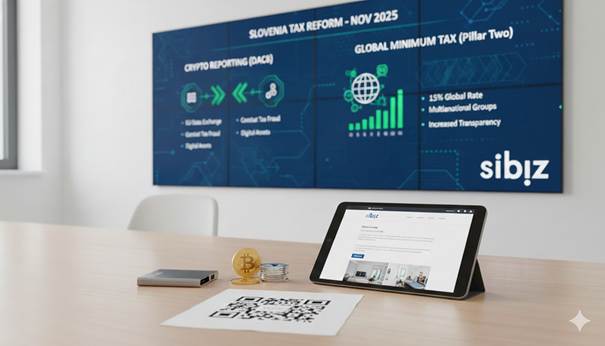
Slovenia approved important tax procedure changes that introduce new EU reporting rules for crypto transactions and strengthen compliance with the global minimum tax framework for multinational groups.
Key points
The amended law implements EU rules on the reporting and exchange of information on income from cryptoassets, with the aim of strengthening cooperation between tax authorities and reducing the risks of cross-border tax fraud, tax evasion and aggressive tax planning.
The second EU directive focuses on the enforcement of the global minimum tax for large multinational and domestic groups operating in the EU.
The new rules aim to increase transparency, efficiency and predictability for taxpayers and tax authorities. Tax write-offs for undeclared income or artificial transactions will no longer be possible. The authorities consider these cases as serious tax evasion.
Installment or deferred payment will be restricted if the taxpayer is already using this option for the same type of tax.
Deadlines for submitting information will be extended by ten days, including deadlines for data related to tax allowances.
Taxpayers must submit this data electronically through eDavki.
There is an exception for paper submission only if digital submission is not feasible.
A new objective deadline replaces the current subjective deadline for payment of additional income tax or corporate income tax. The payment deadline is now 30 days after the legal deadline for filing the tax return.
These updates affect entrepreneurs, companies, investors, digital nomads, freelancers, and business professionals operating in Slovenia.
About SIBIZ Business Services SIBIZ Business Services Ltd, based in Ljubljana, provides accounting, tax, legal, and business advisory support to foreign entrepreneurs, companies, investors, digital nomads, freelancers, business professionals, and corporate clients. We guide clients through Slovenian and EU regulations, compliance, and practical day to day support.
The Ministry of Economy, Labour and Sport (Ministrstvo za gospodarstvo, delo in šport) has officially published the draft amendments to the Employment, Self-Employment and Work of Aliens Act (ZZSDT) on the e-Demokracija public portal. This comprehensive legislative revision brings Slovenian labour regulations into line with Directive (EU) 2024/1233 (the recast Single Permit Directive). The proposed […]
Starting January 1, 2028, a major shift will transform the way business-to-business (B2B) transactions are handled in Slovenia: the mandatory exchange of electronic invoices. This change is mandated by the new Law on the Exchange of Electronic Invoices and Other Electronic Documents (ZIERDED). For foreign founders, expats running local businesses, and corporate managers overseeing operations […]
A recent judgment delivered by the European Court of Human Rights (ECHR) in Strasbourg has set a significant precedent regarding the limits of family reunification across Europe. On 8 September 2026, the Court unanimously ruled in favour of the Netherlands in the case of A.A. v. the Netherlands (Application no. 7481/23), deciding that the Dutch […]